
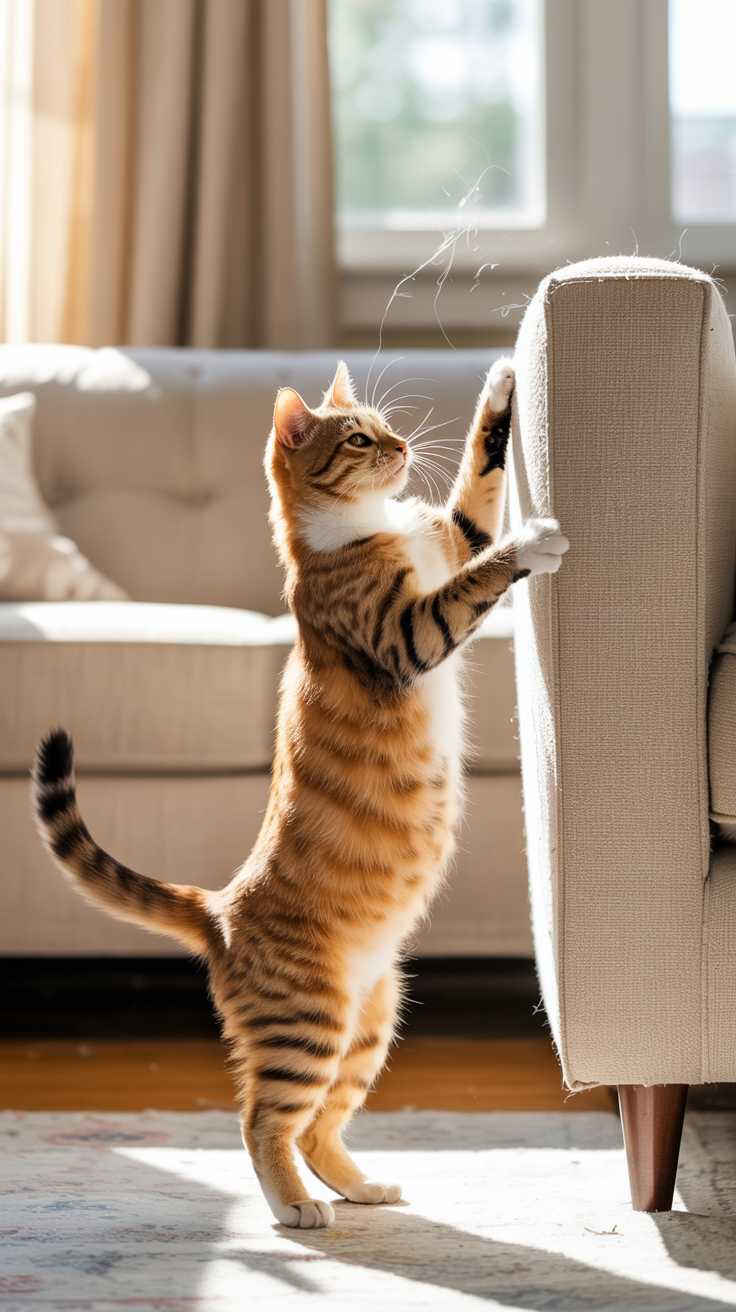
You love your cat. You do not love the shredded couch arms that look like they lost a fight with a cheese grater. Good news: you can keep your furniture intact without turning your living room into a cat-proof bunker.
Even better news: you don’t need to declaw (please don’t), yell, or resign yourself to slipcovers forever. Let’s redirect that tiny menace’s claws like a pro.
Why Cats Scratch (And Why It’s Not “Bad Behavior”)

Scratching is a feature, not a bug. Cats scratch to stretch their bodies, mark territory, shed the outer nail sheath, and blow off steam.
It keeps them sane and healthy. So no, you can’t “stop” scratching entirely. You can only redirect it.
Once you understand the “why,” the “how” gets way easier.
Give Them Something Better to Scratch
If your couch is the only delicious scratchable surface in the room, your cat will pick it every time. Offer options that feel and sound as satisfying. Types of scratchers that actually work:
- Sisal fabric or sisal rope posts: Great durability, satisfying texture.
- Cardboard scratchers: Cheap, messy, and cats love them like it’s their job.
- Carpeted posts: Some cats adore them; others ignore them. Try but don’t rely on only carpet.
- Horizontal scratchers: Perfect for cats that target rugs or couch bottoms.
- Angled or ramp styles: A comfy middle ground for picky paws.
Pro tip: Buy more than one.
Place them in your cat’s favorite rooms and near spots they already scratch. If your cat loves the left arm of the sofa like it’s an ex they can’t forget, put a scratcher right next to that arm.
How to choose the right post
Look for posts that are:
- Tall and sturdy: 30 inches or more so your cat can fully stretch.
- Stable: If it wobbles, your cat will never trust it again.
- Textured: Sisal fabric usually wins the popularity contest.

Make Your Furniture Boring (Temporarily)
Your cat scratches your couch because it’s fun. So let’s make it not fun.
You don’t have to wrap your sofa in aluminum foil (please don’t). Just use a few gentle deterrents while your cat forms new habits. Try these:
- Sticky surface strips: Clear, furniture-safe sticky tape on the target zones.
- Smooth barriers: Couch arm protectors or scratch guards that slide under cushions.
- Throw blankets: A tightly tucked blanket changes the texture and stops the urge.
- Cat-safe scent deterrents: Citrus-based sprays can help, but test on fabric first.
Place the deterrent on the “crime scene,” then put a great scratcher directly next to it. When your cat goes to scratch, boom—better option right there.
After a few weeks, you can remove the deterrents, IMO.
Make the New Scratchers Irresistible
You can’t just plop a scratcher in a dark corner and pray. Sell it to your cat like a luxury product launch. Level up the appeal:
- Catnip or silvervine: Sprinkle or spray on new scratchers.
- Play near the scratcher: Drag a wand toy up the post so your cat rakes it instinctively.
- Reward immediately: Treats and praise the second those claws touch the right surface.
- Daily sessions: 1–2 minutes of “scratch with me” goes a long way.
Location matters more than you think
Cats scratch where they hang out, wake up, and feel social. Put scratchers:
- Near sleeping spots for that post-nap stretch
- By windows and doorways (prime territory-marking real estate)
- Right next to forbidden targets at first, then slowly scoot them to prettier places

Trim, Cap, or Both
Trimming your cat’s nails reduces damage if they do slip up.
It won’t stop scratching, but it lowers the “oh no my couch” factor. Nail game plan:
- Trim every 2–4 weeks: Use cat-safe clippers and go slow.
- Start small: One or two nails per session if your cat gets wiggly.
- Use soft nail caps: Little vinyl caps that glue on and last a few weeks—great for chronic shredders.
How to make trimming not a nightmare
- Touch paws daily and treat for calm behavior.
- Trim after playtime when they feel mellow.
- Stop before they fuss—end on a win, not a wrestling match.
Enrich Their Environment (A Bored Cat Is a Destructive Cat)
If your cat has the 4 p.m. zoomies and zero outlets, your furniture becomes a coping mechanism. Give them things to do that don’t involve upholstery. Simple upgrades:
- Play twice a day: 5–10 minutes with a wand toy until they pant a little, then feed a snack.
- Rotation of toys: Hide half the toys and swap weekly to keep things exciting.
- Vertical space: Cat trees and shelves let them climb and scratch on their own turf.
- Puzzle feeders: Mental work tires them out without chewing your throw pillows.
Stress and territory
Scratching marks territory with scent. If your cat feels insecure—new pet, new couch, new roommate—they’ll scratch more.
Add more scratchers and cozy hideouts. FYI, pheromone diffusers can help anxious cats chill.
Train With Praise, Not Punishment
Punishing cats for scratching never works. Shouting just teaches them to scratch when you’re not around.
You want to make “approved scratching” the easiest, most rewarding choice. Training cheatsheet:
- Interrupt gently: Clap once or toss a soft toy near them, then guide them to the scratcher.
- Reward instantly: Treats, chin scratches, happy voice when they scratch the right thing.
- Consistency beats intensity: 10 small wins per day > one big lecture.
What not to do
- No spray bottles. You’ll just create a sneaky cat.
- No declawing. It’s painful and causes long-term problems.
- No dragging them to the scratcher angrily.Invite, don’t force.
Common Mistakes (And Easy Fixes)
“I bought a scratcher. They ignore it.” Try a different texture, make it taller, or move it to a high-traffic spot. Add catnip.
Play on it. Bribe shamelessly. “They only scratch this one couch arm.” Cover that arm with a guard and park a sisal post right next to it. Reward every time they use the post.
It’s basically habit surgery. “They shred when I leave.” That’s boredom or anxiety. Do a big play session before you go, use a food puzzle, and try a pheromone diffuser. “They scratch carpets.” Get low, horizontal scratchers with rough cardboard. Place one exactly where the carnage happens.
FAQs
How many scratchers do I actually need?
More than you think.
Start with at least two types in different rooms—one tall sisal post and one horizontal cardboard scratcher. If you have multiple cats, double that. Variety keeps interest high and reduces turf wars.
How long before my cat stops scratching the couch?
Expect a couple of weeks of training and redirection.
You’ll see progress fast if you combine deterrents on the couch with irresistible scratchers and rewards. Consistency wins, IMO.
Are certain fabrics more “cat-proof” for furniture?
Yes. Tight weaves like microfiber, canvas, and some performance fabrics resist snagging.
Looser weaves and chenille basically wave a white flag to claws. If you’re buying new, pick tight, smooth textures and avoid dangling threads.
Do pheromone diffusers really help?
They can. Pheromones reduce anxiety and territorial scratching for some cats, especially during changes (new furniture, new home, new pets).
They won’t replace training, but they support it nicely.
Is it okay to use aluminum foil or double-sided tape?
Tape: yes, if it’s furniture-safe and temporary. Foil: sometimes, but it looks like a sci-fi prop and falls off. Clear scratch guards or sticky strips look cleaner and work better long-term.
My cat shreds at night.
What do I do?
Burn that energy before bedtime. Do a solid play session, feed a small meal, and close off rooms with tempting furniture overnight while you’re training. A bedtime treat puzzle helps too.
Conclusion
You don’t need to choose between your cat and your couch.
Give them better places to scratch, make the wrong spots boring, and reward like crazy when they get it right. Add trims, playtime, and smart placement, and you’ll have a happy cat and furniture that stops looking like modern art. Small tweaks, big payoff—your living room will thank you.
And, IMO, your cat will too, in their own chaotic, adorable way.