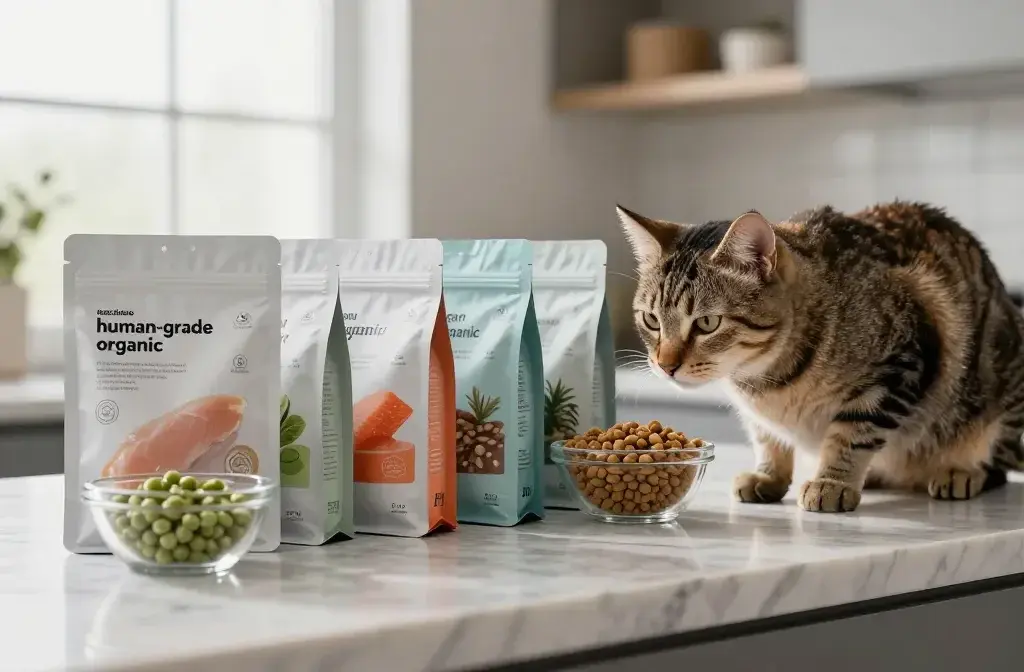
If your cat eats with more enthusiasm than you read labels, you’re not alone. Pet food packaging loves big, shiny buzzwords that sound healthy, but do they actually mean anything? Some do. Some don’t. Let’s decode “human-grade,” “organic,” and “holistic” so you can shop smarter and keep your tiny house tiger happy.
Why Cat Food Labels Feel Like a Puzzle
Cat food brands throw around terms that sound scientific, ethical, or gourmet. You see a pretty bag, a cat with glossy fur, and suddenly “holistic salmon pâté” looks like a life upgrade. But not all claims carry equal weight. Some are legally defined. Others? Pure marketing fluff wrapped in good intentions.
Bottom line: You need to know which words are regulated and which are vibes. Once you get that, you’ll shop with confidence—and maybe even save money.
“Human-Grade” — What It Actually Means
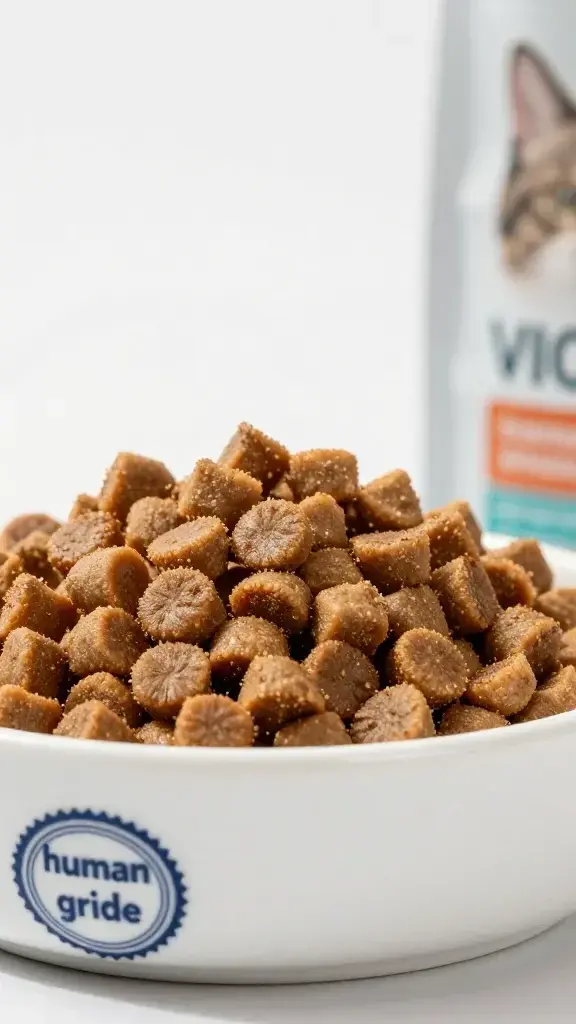
“Human-grade” sounds fancy because it is. For a food to be truly human-grade, every ingredient and every step of production must meet human food standards. That includes sourcing, handling, processing, transportation, and the facility itself.
What to look for:
- Whole supply chain compliance: Ingredients and the kitchen meet human food rules, not just the final product.
- Clear claims on packaging: Reputable brands explain the standard and often link to audits or certifications.
- Price check: It usually costs more due to stricter manufacturing.
Is Human-Grade Automatically Better?
Not always. Cats need specific nutrients (hello, taurine) and a meat-first diet. AAFCO-compliant “feed-grade” food can still be excellent if it meets all nutritional needs. FYI: “Human-grade” describes quality and handling, not balanced nutrition.
“Organic” — A Real Standard (With Nuance)
“Organic” carries legal meaning when certified. In the U.S., the USDA oversees it for both ingredients and processing. If you see:
- “Organic” or “100% Organic” with a USDA seal: Means the product meets specific organic standards.
- “Made with organic [ingredients]”: At least 70% organic content. No USDA seal allowed.
Why choose organic? You avoid synthetic pesticides and support certain farming practices. That’s great for the planet and, IMO, often for ingredient quality. But nutritionally, organic chicken isn’t more “cat-healthy” than non-organic if both meet AAFCO standards. Cats care about amino acids, not agricultural politics.
Organic Pitfalls to Watch
- Partial organic claims: Some brands highlight one organic ingredient while the rest isn’t. Read the ingredient list.
- Price vs. payoff: Organic often costs more without guaranteed nutritional superiority.
“Holistic” — The World’s Most Flexible Word
“Holistic” sells a vibe: whole-body wellness, balance, premium ingredients. But there’s no official definition for pet food. Anyone can slap “holistic” on a bag and call it a day.
How to judge a “holistic” product anyway:
- Check AAFCO statement: Look for “complete and balanced” for your cat’s life stage.
- Ingredient transparency: Whole meats and clear sources beat vague terms like “animal digest.”
- Feeding trials vs. formulation: Trials add confidence that cats actually thrive on it.
Other Label Claims You’ll See (and What They Mean)
Let’s speed-run a few more terms you’ll bump into when you squint at labels in the pet aisle.
- “Natural”: Typically means no chemically synthetic additives, except for vitamins, minerals, and trace nutrients. Still broad. Still needs context.
- “Grain-free”: No corn, wheat, rice, etc. Does not equal low-carb. Many grain-free foods swap in peas or potatoes. Cats are obligate carnivores; protein quality matters more.
- “Limited Ingredient Diet (LID)”: Fewer ingredients to help pinpoint allergies. Can help sensitive cats, but still check the AAFCO statement.
- “With [ingredient]”: U.S. labeling rules allow this if the ingredient is at least 3% of the product by weight. “With salmon” doesn’t mean mostly salmon.
- “Flavor” claims: “Chicken flavor” can mean very little actual chicken. Flavor ≠ main ingredient.
How to Read the Label Like a Pro
You don’t need a PhD, just a system. Here’s a quick way to cut through the noise.
- Find the AAFCO statement: Look for “complete and balanced” and the life stage (kitten, adult maintenance, all life stages). This is non-negotiable.
- Scan the first five ingredients: Aim for named animal proteins (chicken, turkey, salmon) over vague ones (“meat by-product”). Cats thrive on animal protein, not marketing adjectives.
- Check protein and fat: For most adult cats, you want high protein and moderate fat. Carbs should stay modest, especially in dry food.
- Look for taurine: It should be added to most recipes. Critical for heart and eye health.
- Assess additives: Natural preservatives (mixed tocopherols) are common. Avoid artificial colors—your cat doesn’t care if kibble is rainbow confetti.
- Feeding guidelines and calories: Confirm kcal/cup or kcal/can so you don’t overfeed. Chonky cats are cute, but not healthy.
Wet vs. Dry vs. Fresh
- Wet food: Higher moisture (yay kidneys), often more species-appropriate. Great for picky eaters.
- Dry food: Convenient and cheaper per calorie. Watch carbs and portion sizes.
- Fresh/frozen or gently cooked: Often “human-grade.” Pricey but palatable. Ensure AAFCO adequacy and safe handling.
Ingredient List vs. Guaranteed Analysis
The ingredient list tells you sources; the guaranteed analysis tells you amounts. Both matter.
For obligate carnivores:
- Protein: Wet foods often list 8–12% protein as fed, which jumps when converted to dry matter. Compare apples to apples using dry matter basis if you want to nerd out.
- Fat: Provides energy and helps absorption of fat-soluble vitamins.
- Ash: Not scary. Just minerals. Look for reasonable levels, especially in urinary-support diets.
Red Flags
- No AAFCO statement: That’s a soft “nope” for daily feeding.
- Vague proteins: “Animal” or “meat” without species named? Hard pass, IMO.
- Overpromising claims: “Cures allergies,” “detox,” “ancestral miracle blend.” If it sounds like a late-night infomercial, skip it.
Budget vs. Premium: Finding Your Sweet Spot
You can feed your cat well without buying the most expensive bag in the store. Price often reflects ingredient sourcing, packaging, and brand marketing—not just nutrition. Focus on:
- AAFCO completeness and appropriate life stage.
- Named animal proteins high on the list.
- Moisture intake (add wet food or a water fountain if you mainly feed kibble).
If a “human-grade organic holistic” option fits your budget and your cat devours it, great. If not, you can still crush it with a well-formulated, non-buzzy brand. Your cat will judge you either way.
FAQ
Does “human-grade” mean I can eat my cat’s food?
Technically, if it’s truly human-grade and produced in a human food facility, it should be edible. But it’s formulated for cats, not your palate or nutrient needs. Also, you’ll hate it. Trust me.
Is organic cat food healthier?
Not by default. Organic refers to how ingredients are grown and processed, not whether the recipe meets feline nutritional needs. If both organic and non-organic foods are complete, balanced, and high in quality animal protein, your cat’s body won’t know the difference.
What does “holistic” actually do for my cat?
Nothing specific, because it’s not regulated. It can signal a brand’s philosophy, but you still need to verify AAFCO completeness, protein quality, and ingredient clarity. Think of “holistic” as a mood, not a metric.
Should I avoid grains?
Not automatically. Some cats do fine with grains; some don’t. Grain-free foods can be higher in legumes or starches, which isn’t automatically better. Prioritize animal protein and total formulation over the grain debate.
How do I switch foods safely?
Transition over 7–10 days: start with 25% new food, then 50%, 75%, and finally 100%. This prevents tummy drama and gives you time to watch for itchiness, vomiting, or litter box changes.
Do cats need variety?
Variety helps prevent pickiness, boredom, and over-reliance on one protein source. Rotate proteins or brands that agree with your cat, but change slowly and stick to complete-and-balanced options.
Conclusion
“Human-grade” and “organic” mean something. “Holistic” mostly doesn’t. The real power move? Read past the buzzwords. Prioritize an AAFCO “complete and balanced” statement, named animal proteins, and appropriate moisture. Add a dash of budget sanity and a slow transition, and you’ll feed like a pro—no decoder ring required. FYI: your cat still thinks the box the food came in is the real treat.