
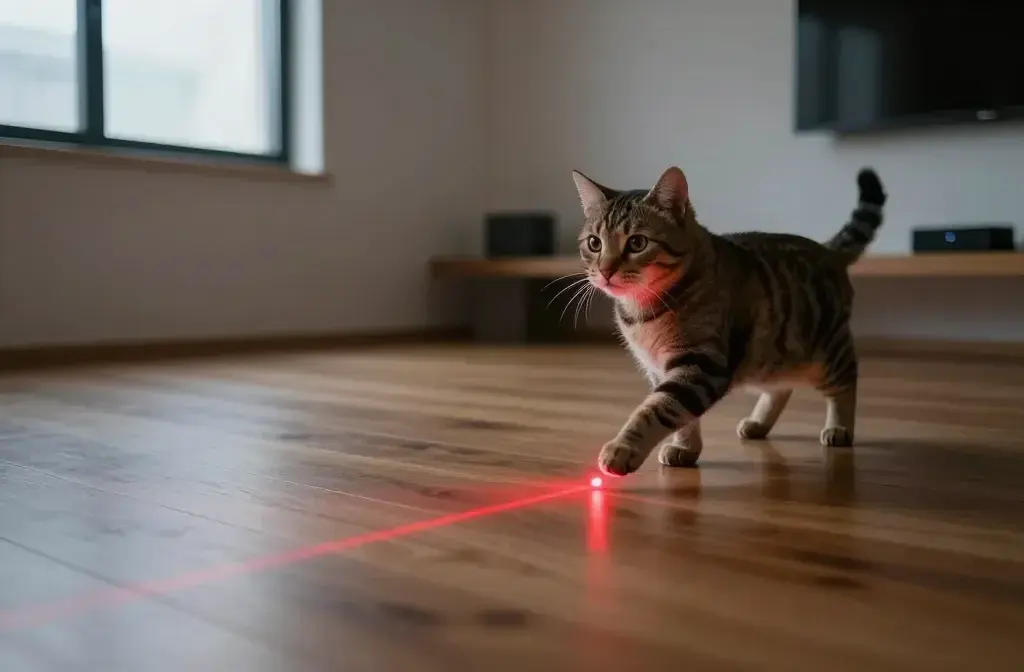
Your cat sees a moving dot and morphs into a zooming gremlin. So an automatic laser toy sounds like the perfect hack, right? Set it, forget it, and let your furry chaos machine chase imaginary prey while you drink coffee in peace. But do these gadgets actually entertain your cat—or just make them confused, frustrated, and weirdly suspicious of the wall? Let’s dig in and find out.
What Automatic Laser Toys Actually Do
Automatic laser toys project a moving red dot in random patterns. Some sit on a shelf and pan around. Others mount on the wall or clip to a perch. Many add timers and speed modes to keep the game unpredictable.
You press a button and the dot zips around like a tiny UFO. Cats stalk, pounce, and sprint. The draw is obvious: hands-free play that burns energy fast. If your cat treats 3 a.m. like CrossFit class, this sounds like salvation.
The Big Win: Exercise Without Effort
Cats need to move. Boredom can lead to zoomies, anxiety, or furniture annihilation. Automatic lasers deliver cardio with zero effort from you.
Why lasers hype cats up
– They trigger the prey drive—fast, erratic movement screams “chase me.”
– Sessions stay short and intense, similar to real hunting bursts.
– You can schedule regular bursts throughout the day.
Best scenarios for an auto laser
– High-energy indoor cats who nap all day and go feral at night.
– Busy humans who can’t always do wand-toy play.
– Multi-cat households where turns happen naturally (with a little referee work from you).
FYI: Some cats won’t give the laser the time of day. You know your weirdo best.
The Catch: No “Kill,” No Closure
Here’s the rub. Lasers never let the cat catch actual prey. Chase without a capture can frustrate some cats. You might see zoomies turn into grumbles or random ankle bites. Not ideal.
Fix the frustration with a “catch” ritual
– End every session with a real, catchable toy—a kicker, mouse, or wand toy.
– Let them “kill” the toy for a minute.
– Follow with a small treat or snack to simulate a “meal after the hunt.”
– Keep laser sessions short: 5–10 minutes max.
Do that and you’ll turn chaos into a healthy hunt cycle. Skipping it? IMO, you risk a cranky feline.
Features That Actually Matter
Plenty of laser toys look cute. Ignore the gimmicks. Focus on these practical features:
- Randomized patterns: Avoid predictable loops. Cats clock patterns fast.
- Adjustable speed: Kittens need faster zips; seniors need gentler paths.
- Timer and auto-shutoff: Prevent overstimulation and endless spinning.
- Quiet motor: No one wants a whining droid in the living room.
- Stable base or mount: Tippy toys become chew toys.
- Safe laser rating: Look for Class 1 or 2; don’t DIY a death beam.
- Battery vs. USB: USB saves money and headaches long-term.
Nice-to-have extras
– Motion sensors that start the toy when your cat strolls by.
– Programmable play windows to stop 3 a.m. cat marathons.
– Angle adjustment so the dot stays on the floor or wall, not your eyeballs.
Safety and Sanity Checks
Lasers look harmless, but let’s keep your cat’s eyes—and your sanity—intact.
- Never shine the laser in eyes, feline or human. Even brief hits can irritate.
- Watch the play surface: Smooth floors are okay; clutter invites collisions.
- Limit sessions to avoid overheating or obsessive behavior.
- Supervise at first. Some cats escalate from play to frustration fast.
- Secure placement so the beam doesn’t jump to reflective glass or shiny fridges.
Signs your cat gets annoyed
– Chirping or yowling while chasing
– Redirected aggression (ankles, other pets)
– Pacing and searching after the toy shuts off
If you see those, shorten sessions and add that “catch” ritual. Works wonders.
Real-World Pros and Cons
Let’s keep it real for a second.
Pros:
- Massive energy burn in minutes
- Hands-free play for busy days
- Great enrichment for indoor cats
- Entertaining to watch (yes, this matters)
Cons:
- No tactile feedback—can frustrate some cats
- Cheaper models feel noisy or jittery
- Battery replacements get annoying
- Not all cats “get it” or care
IMO, the pros win if you treat the laser as part of a routine, not the whole routine.
How to Introduce the Toy Without Drama
Don’t just fling red chaos at your cat and hope for the best. Warm them up.
- Start slow: Use the slowest speed and keep the dot near the floor.
- Mix in catchable toys: Alternate 1–2 minutes of laser with a wand toy.
- End with a “kill” and snack.
- Set a schedule: Same windows daily = predictable energy outlet.
- Observe and tweak: If your cat looks skeptical, shorten or slow things down.
Cats trust routines. Build one and you’ll avoid the “confused loaf with murder eyes” vibe.
Top Picks by Use Case
I won’t lock you into one brand, but here’s what to look for based on your situation:
For night-owl cats
– A programmable toy with quiet operation and auto-shutoff
– Wall-mounted or high-shelf placement so it doesn’t become a hockey puck
For anxious or sensitive cats
– Slower speed settings, gentle arcs
– Very short sessions followed by tactile play
For multi-cat households
– Wide sweep pattern so both cats get turns
– Keep throw toys nearby to “split” attention if tensions rise
FAQs
Are automatic laser toys safe for my cat’s eyes?
Yes, if you use toys with Class 1 or Class 2 lasers and avoid direct eye contact. Place the toy to keep the beam on the floor or wall. If it bounces off shiny surfaces, reposition it.
Will a laser toy make my cat more aggressive?
It can increase frustration if you never let them “catch” something. End sessions with a physical toy and a small treat to complete the hunt cycle. Most cats relax after that.
How long should each session last?
Aim for 5–10 minutes. High-energy cats can handle two or three sessions a day. More isn’t better if your cat fixates or paces afterward.
Can kittens or senior cats use laser toys?
Absolutely, with adjustments. Kittens do great with faster, bouncy patterns. Seniors need slow arcs and soft surfaces to prevent slips. Keep sessions shorter for both.
Do I still need other toys if I use a laser?
Yes. Lasers are cardio. Wand toys, kickers, puzzle feeders, and scratchers add variety and tactile satisfaction. Think of the laser as a workout, not the whole enrichment plan.
What if my cat ignores the laser?
Some do. Try dimmer lighting, slower speeds, and starting the dot near their paws. If they still shrug, pivot to wand toys or motorized mice. No single toy wins every cat.
Conclusion
Automatic laser toys can be a blast—and a sanity saver—when you use them thoughtfully. Keep sessions short, add a “catch,” and build a routine. If your cat zooms with joy and then lounges like a tiny lion after, you nailed it. If they seem annoyed, tweak the settings or switch toys. At the end of the day, the best toy is the one your cat loves—and the one you’ll actually use, IMO.